Successful projects don’t happen by chance — they are planned.
The project planning process is one of the most critical phases of project management, as defined in the PMBOK® Guide. It creates clarity, establishes control, and reduces uncertainty long before execution begins.
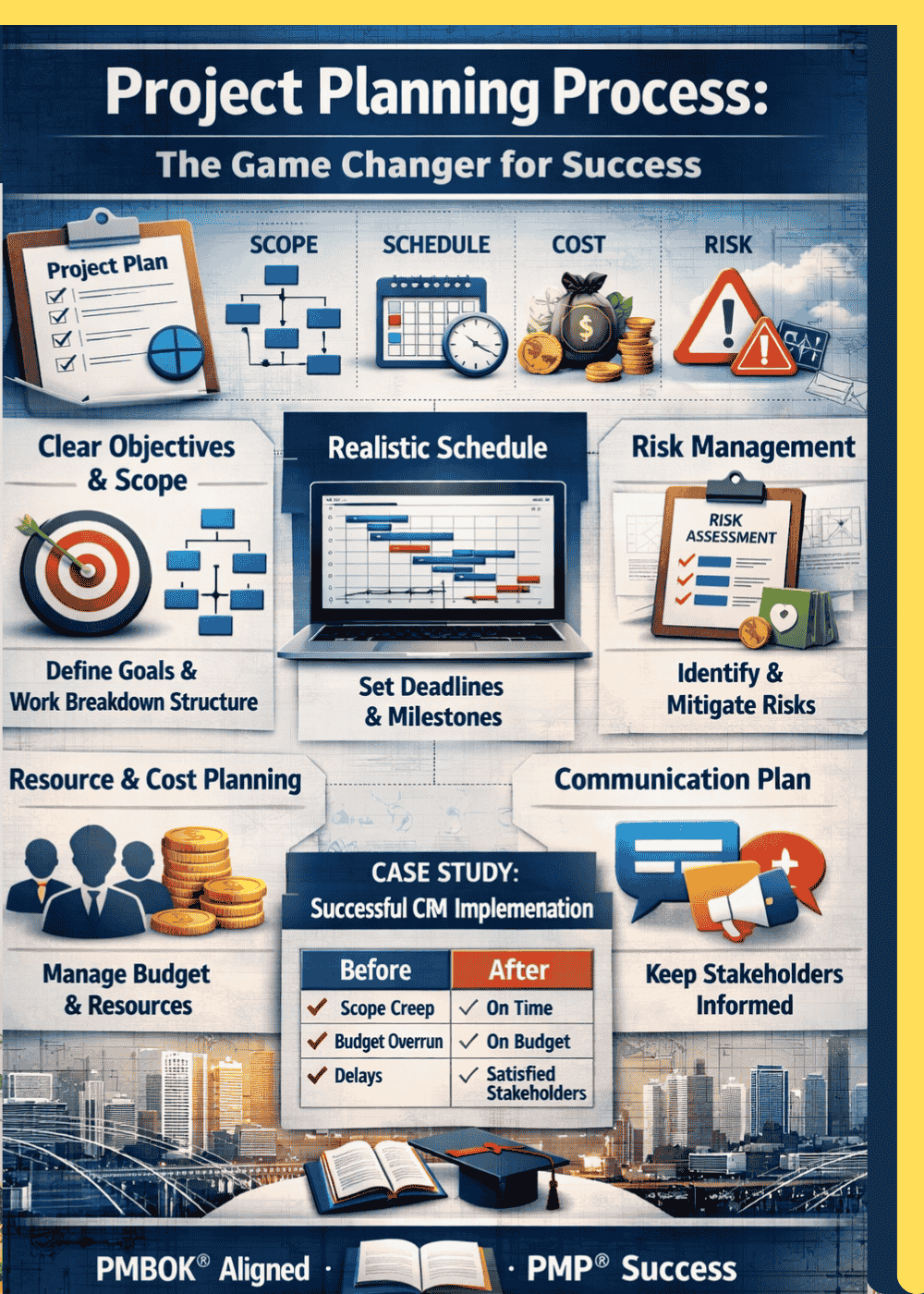
In PMP® terms, effective planning ensures that scope, schedule, cost, quality, risk, and communication are all aligned to support project objectives.
Why the Project Planning Process Matters (PMBOK Perspective)
According to PMBOK®, planning is not a single activity — it is a group of interconnected processes that collectively guide execution and control.
A strong project planning process helps project managers:
- Define what will be delivered
- Decide how work will be performed
- Identify risks before they occur
- Set realistic expectations for stakeholders
📌 Planning transforms uncertainty into structured decision-making.
1. Define Clear Project Objectives and Success Criteria
In PMP terminology, this aligns with:
- Develop Project Management Plan
- Collect Requirements
Clear objectives ensure that:
- Stakeholders share a common vision
- Performance can be measured objectively
- Changes are evaluated logically
Without clear goals, even well-executed work can fail.
2. Scope Planning Prevents Scope Creep
Scope planning includes:
- Define Scope
- Create Work Breakdown Structure (WBS)
A well-defined WBS:
- Breaks deliverables into manageable components
- Improves estimating accuracy
- Reduces ambiguity
📌 In PMP exams, poor scope planning is a leading cause of project failure.
3. Schedule Planning Enables Predictability
Schedule planning involves:
- Define Activities
- Sequence Activities
- Develop Schedule
By identifying dependencies and milestones early:
- Critical paths are visible
- Delays are easier to manage
- Stakeholders gain confidence
📊 Predictable schedules come from detailed planning, not aggressive deadlines.
4. Cost and Resource Planning Support Budget Control
PMBOK links this to:
- Estimate Costs
- Determine Budget
- Plan Resource Management
Effective planning ensures:
- Balanced workloads
- Controlled spending
- Fewer last-minute resource conflicts
💡 A realistic budget is a product of realistic planning.
5. Risk Planning Reduces Issues During Execution
Risk planning includes:
- Identify Risks
- Perform Qualitative Risk Analysis
- Plan Risk Responses
Instead of reacting to problems, teams:
- Anticipate threats
- Prepare mitigation strategies
- Respond faster and smarter
🚨 Well-planned risks rarely become project-ending issues.
Real-World Case Study on Project Planning Process: IT System Implementation Project
Project Overview
An organization planned a customer relationship management (CRM) system implementation for 500+ users.
Without Strong project planning process (Initial Attempt)
- Unclear scope led to constant change requests
- Schedule slipped by 3 months
- Budget overran by 25%
- Stakeholder dissatisfaction increased
With a Structured project planning process
The project manager re-planned using PMBOK principles:
- Created a detailed WBS
- Developed a realistic project schedule
- Identified key technical and adoption risks
- Established a clear communication plan
Results
✔ Project delivered on revised schedule
✔ Budget variance reduced to under 5%
✔ Stakeholder satisfaction improved
✔ Smooth user adoption
📌 Planning turned a failing project into a controlled recovery.
6. Communication Planning Keeps Stakeholders Engaged
PMBOK emphasizes:
- Plan Communications Management
This defines:
- Who receives what information
- Frequency of reporting
- Communication methods
📣 Clear communication planning reduces conflict and confusion.
Why PMP-Certified Project Managers Emphasize Planning
PMP-certified professionals understand that:
- Execution follows the plan
- Monitoring depends on baselines
- Change control relies on documented plans
🎯 Strong planning separates reactive managers from strategic leaders.
Final Thoughts
The project planning process is not paperwork — it is the foundation of project success.
When planning is done right:
- Execution becomes smoother
- Risks are controlled
- Stakeholders trust the process
📌 Plan thoroughly. Execute confidently. Deliver successfully.